Borrowed Faces, Broken Trust: Why Generic Photography Lets Down UK Service Websites
Somewhere on a stock library server there is a man in a hard hat pointing at a clipboard. He has been pointing at that clipboard for years. He has appeared on websites for electricians, surveyors, software companies and at least one wedding venue. He is not real, not local and not going to turn up at your customer's door.
That is the quiet problem with generic photography on UK service websites. The issue is not that stock images are fake. All photography is staged to some degree. The issue is that a stock photo often makes a promise the business cannot keep. It borrows trust from a stranger and spends it on your homepage.
Visual lorem ipsum with a smile
Stock images are the visual equivalent of placeholder text, except nobody mistakes lorem ipsum for a real sentence. A photograph of a smiling call centre worker in a headset looks like a claim. A handshake over a glass desk looks like evidence of a partnership. A team gathered around a laptop in a bright office looks like your team, even when it is not.
Visitors do not read websites the way designers do. They scan for signals. Who are these people? Where are they based? Have they done this before? Will they treat my home, shop or office with care? A generic image answers none of those questions. Worse, it introduces a small doubt: if the photo is borrowed, what else is?
What buyers are actually trying to work out
A UK service buyer is usually not comparing twenty options. They are trying to reduce risk. They want to know whether the person arriving will be competent, insured, local enough to come back and unlikely to leave a mess. They want to know whether the firm understands the difference between a Victorian terrace, a retail unit and a serviced office.
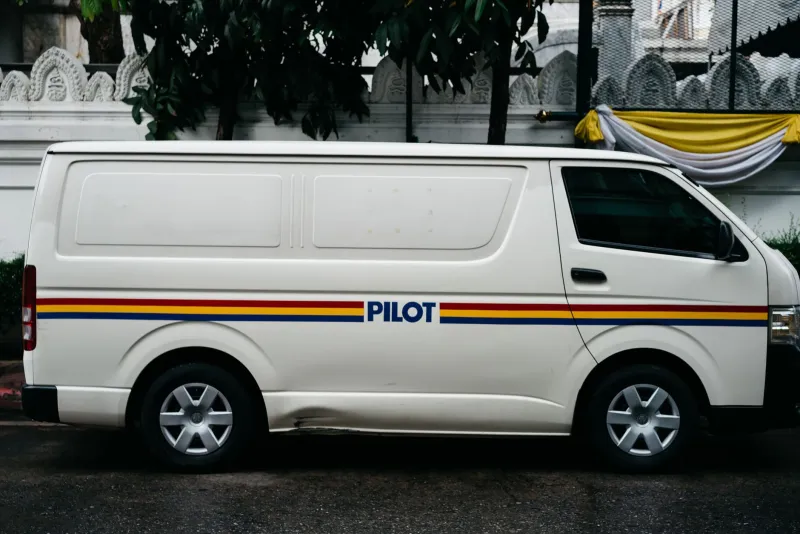
Stock photography rarely helps with any of that. A picture of a generic van with no branding tells you nothing. A glass tower reception desk tells you nothing if the business operates from a unit on an industrial estate. A stock smiling engineer tells you nothing about whether the actual engineer will explain the job before starting.
Real imagery does not need to be beautiful. It needs to be useful. One slightly wonky phone photo of a branded van outside a real address can do more conversion work than six polished images of strangers in lanyards.
A practical hierarchy: people, premises, process
When UK service firms ask what to photograph, the answer is usually sitting in the business already. Work down this list and stop when you have enough.
1. People
Start with the people who do the work. Not a row of models against a white wall. A founder at a desk, an engineer checking a boiler, a surveyor measuring a room, a receptionist at the actual reception desk. Names and roles help. So do short captions.
You do not need a full team shoot. A single real photo on the about page and another near the enquiry form can change the feel of a site. If staff do not want their faces online, show hands, tools or the back of a uniform. Consent matters, and so does common sense. Do not use a stock face and caption it as your team.
2. Premises and kit
Show the place and the equipment. The workshop, the yard, the van, the storage unit, the office, the tools laid out before a job. This is especially powerful for trades and local services because it proves scale and locality. A customer in Leeds can tell the difference between a firm with a Leeds base and a firm pretending to be local.
If your premises are not impressive, do not fake it. A tidy unit with a clear sign is more reassuring than a stock photo of a corporate lobby. Honesty is not a design compromise. It is the point.
3. Process
Process photos answer the question every service website should address: what happens after I enquire? A photo of a survey, a delivery, a fitting, a handover or a tidy-up says more than a paragraph of vague reassurance. It also gives you natural captions for service pages.
You do not need to show client faces or private homes without permission. Focus on the work: the clipboard, the checklist, the protective covers, the van being loaded. This is the visual equivalent of a clear next step.
Where stock can still earn its place
Stock photography is not banned. It can work as a category cue on a blog post, a background texture, an abstract header or an illustration of a concept. It can be useful when showing real people would create privacy or confidentiality problems. It can fill a gap while you organise a proper shoot.
But it should not pretend to be your team, your premises or your process. If the image is doing identity work, use a real image. If it is doing decoration work, stock is fine. The trouble starts when decoration quietly becomes a claim.
The three-question test
Before you upload an image, ask three questions.
- Does it answer a question a buyer actually has? Who, where, how, what happens next?
- Could a competitor use the exact same image without lying? If yes, it is not helping you stand out.
- Would you be comfortable with an honest caption? If the caption has to say 'our team' when it is not, the image is doing the wrong job.
There is a simpler version too: the front-door test. If a customer walked into your premises, would they recognise the person or place in the photo? If not, treat it as decoration, not proof.
A small shoot list for a Tuesday afternoon
You do not need a studio. A phone, daylight and twenty minutes can cover most of it:
- A founder or team member doing the actual job.
- The front of the premises with the sign visible.
- A branded van or vehicle, if you have one.
- Tools, kit or stock laid out neatly.
- A job in progress, with permission.
- A handover or completion moment, without client faces unless agreed.
Keep the files sensibly sized, write descriptive alt text and add captions where they help. A real photo with a plain caption beats a perfect stock image with no context.
Swap one image at a time
You do not need a full redesign. Start with the pages that matter to conversion: the homepage hero, the about page, the main service page and the contact page. Replace one borrowed image with a real one. Add a caption. See whether enquiries feel better qualified or whether the site simply feels more like the business.
The aim is not authenticity as an aesthetic. It is evidence. Stock photos fill space. Real photos reduce uncertainty. For UK service firms, that is usually the difference between a visitor who browses and a visitor who calls.